
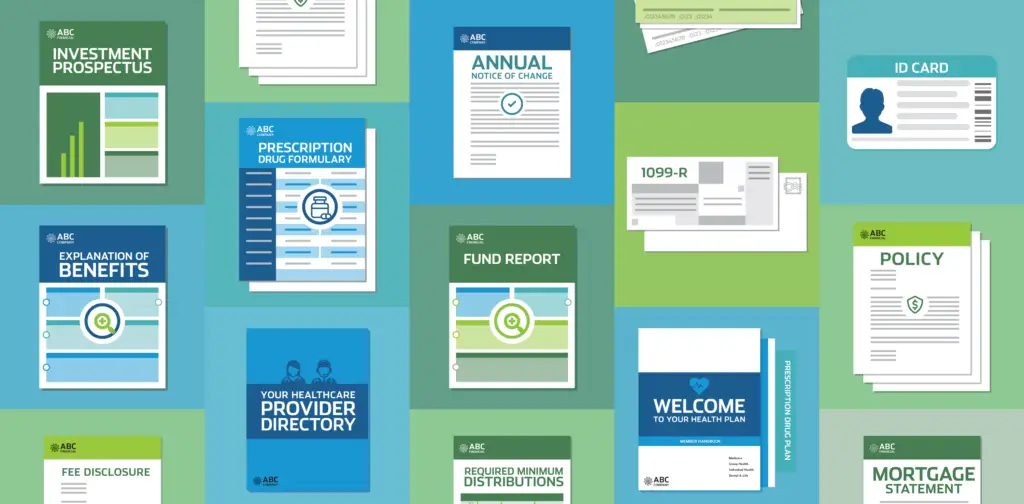
Digital transformation has reshaped how organizations communicate, but it has not changed how people build trust, understand complex information, or make high-stakes decisions. In fact, omnichannel customer communications are increasingly important as organizations seek to communicate effectively across multiple platforms. Across healthcare, financial services, and insurance, leaders are recognizing a critical truth: print remains essential to effective customer communication management, even as digital channels continue to expand.
The question is no longer whether to choose print or digital. The question is how to orchestrate both within a unified omnichannel communication strategy that improves experience, controls cost, and reduces risk.
Digital Scale Didn’t Replace Human Understanding
Digital channels have expanded reach and immediacy, but they also suffer from information overload and declining engagement. When compared to print, digital response rates tell a revealing story: direct mail campaigns routinely outperform digital marketing in terms of response and engagement. Industry reports show that print and direct mail efforts produce response rates around 4.9% to 5.3% for existing audiences and higher than 2.9% for prospects, while digital channels like email average less than 1% response rates in many cases.
Other data highlights how attention differs by medium. A single piece of direct mail can hold attention for roughly 132 seconds on average, compared with fleeting engagement for many digital ads, which are typically measured in seconds.
These results underscore that when the information is important — like healthcare coverage details, financial statements, or insurance disclosures — print’s tangible format naturally fosters deeper engagement.
Print Builds Trust Where Stakes Are Highest
Trust and memorability are critical in regulated industries. Consumers consistently express higher trust in print communications relative to online alternatives. Surveys indicate that 56% of customers find print marketing to be the most trustworthy type of communication, and direct mail often achieves brand recall rates up to 70% higher than digital channels when paired with digital outreach.
Moreover, a strong majority of marketers recognize that print remains a cornerstone of effective communications, with 74% agreeing that direct mail delivers superior response and ROI compared to other channels. In practical terms, this means that when healthcare members or financial services customers receive a letter, statement, or policy update in print, it not only captures their attention but also reinforces credibility — a key driver of satisfaction and loyalty.
Omnichannel Customer Communication Requires Orchestration, Not More Channels
Print and digital are not adversaries in the communication mix — they are complementary. Research consistently shows that campaigns combining physical and digital channels dramatically outperform single-channel efforts. Marketing integrations that pair direct mail with digital advertising can see up to a 400% lift in overall effectiveness and significantly improved digital engagement metrics such as website visits and lead generation.
This synergistic effect aligns with customer expectations in regulated sectors, where people often start with a print document and then transition to digital touchpoints — using QR codes, portals, and interactive tools for deeper exploration and self-service. Such coordinated approaches are the essence of effective omnichannel communication strategies.
Print Accelerates Digital Adoption When Used Strategically
One of the most overlooked aspects of digital transformation is the role print plays in driving digital success.
Printed communications are often the most effective way to introduce portals, explain digital options, address security concerns, and guide customers through enrollment or opt-in processes. In healthcare and financial services, organizations frequently see higher digital adoption when print is used to educate and reassure rather than eliminated prematurely.
The outcome is not resistance to digital channels, but adoption driven by confidence and understanding.
Cost Efficiency Comes From Integration, Not Elimination
Print is often labeled a cost center, but unmanaged communication ecosystems are the real source of inefficiency.
When print is disconnected from data, fragmented across vendors, and measured separately from digital, costs escalate quickly. When print and digital share content, rules, analytics, and governance within a unified platform, communication becomes predictable, measurable, and optimized across channels.
The same discipline applied to digital transformation must apply to print management.
What This Means for Executive Leadership
For leaders in healthcare, financial services, and insurance, communication strategy has become a business issue—not just an operational one. How you communicate directly affects customer trust, regulatory performance, and cost.
Many organizations pursued digital-first strategies with good intent, but the results are mixed. In practice, removing print too quickly often leads to confusion, higher call volumes, and fragmented experiences—especially when communications are complex or highly regulated. Digital alone does not always deliver clarity.
Leading executives are shifting the focus from eliminating channels to coordinating them. The goal is not fewer touchpoints, but better ones. Print and digital each serve a purpose, and the strongest results come when they are managed together through a unified strategy.
This approach also delivers measurable operational benefits. Clear, well-orchestrated communications reduce inbound service calls, lower compliance risk, and simplify vendor and technology ecosystems. When print and digital are governed together, organizations gain visibility, consistency, and control.
Most importantly, customers and members experience organizations through moments—not channels. Enrollment, renewals, claims, policy changes, and financial decisions all demand communication that is clear, timely, and appropriate to the situation. In those moments, print still plays a meaningful role alongside digital.
Print is not holding digital back. It strengthens it.
The organizations that will stand out in the years ahead will not be defined by how quickly they went paperless, but by how effectively they aligned print and digital to deliver clear, trusted, and consistent communication at scale.
About O’Neil Digital Solutions
O’Neil Digital Solutions is a customer communication management (CCM) and CX technology provider serving healthcare and financial services organizations, specializing in compliant, omnichannel, high-volume communications across print and digital channels, powered by the ONEsuite® platform. These communications are designed to improve customer and member experiences while meeting the demands of highly regulated industries.