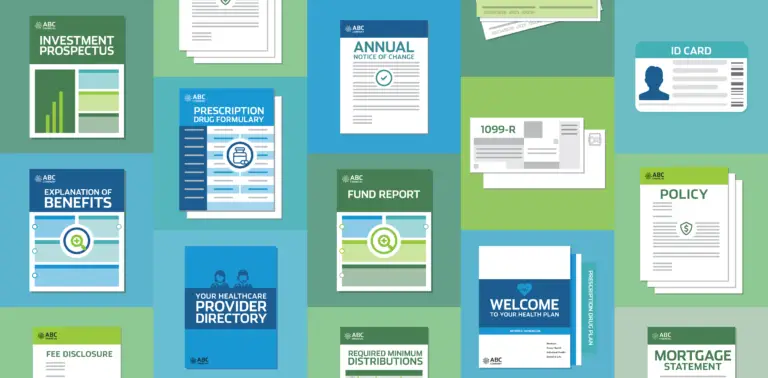

The quarterly statement arrives. It gets glanced at, maybe filed, probably forgotten. Three months later, another one arrives. The cycle repeats.
For decades, this has been the dominant model for retirement plan communication: periodic, compliance-driven documents that inform participants about their account status but do little to influence their behavior. The information is accurate. The regulatory boxes are checked. But the opportunity to actually help people prepare for retirement—to move them from passive account holders to engaged participants—remains largely untapped.
Leading retirement services providers are recognizing that this model, while compliant, leaves significant value on the table. The shift underway isn’t about adding more communications or making statements flashier. It’s about fundamentally rethinking what participant communication is designed to accomplish—and building the operational capability to deliver on that ambition.
The Engagement Problem Is an Outcomes Problem
Low participant engagement isn’t just a communication challenge—it’s a business challenge with measurable consequences. Participants who don’t engage tend to under-contribute, miss employer matches, and make suboptimal investment decisions. For providers, this translates directly to lower assets under management, reduced fee revenue, and diminished value delivered to plan sponsor clients.
The root cause often isn’t lack of information. Participants receive plenty of materials—enrollment packets, quarterly statements, annual notices, fee disclosures. The problem is that these communications arrive disconnected from the moments when participants are most likely to act. A statement that shows a participant is under-saving lands in a mailbox alongside bills, catalogs, and other noise. By the time it’s opened—if it’s opened—the moment of receptivity has passed.
More fundamentally, traditional retirement communications treat all participants the same way. A 28-year-old saving for a first home receives essentially the same quarterly statement as a 58-year-old approaching retirement. The messaging doesn’t reflect their different circumstances, concerns, or motivations. It informs without persuading, reports without guiding. The same generational blind spot shows up further down the funnel as wealth transfer client retention risk — heirs treated as a mailing list rather than a relationship.
What Behaviorally-Informed Communication Looks Like
The providers seeing meaningful lifts in participation and contribution rates have moved beyond the statement-centric model. They’re applying behavioral science principles to retirement communication—understanding that how and when a message is delivered matters as much as what it says.
This starts with segmentation that goes deeper than demographics. Leading providers are analyzing participant behavior patterns: Who has logged into their account recently? Who increased their contribution after a salary change? Who has a loan outstanding? Who is approaching a milestone age? These behavioral signals create opportunities for communication that feels relevant rather than routine.
Timing shifts from calendar-driven to event-driven. Instead of waiting for the quarterly cycle, communication triggers when something meaningful happens—a participant becomes newly eligible, reaches a vesting milestone, pays off a plan loan, or hasn’t logged in for six months. The message arrives when the participant has context for it, when action is natural rather than abstract. Event-driven outreach lives or dies on the underlying customer data in financial services — stale records produce noise, not nudges.
Messaging becomes personalized to individual circumstances. A participant saving below the employer match threshold receives communication focused specifically on that gap—not generic encouragement to save more, but a concrete illustration of the dollars they’re leaving on the table. A participant with competing financial priorities receives messaging that acknowledges those realities and shows how modest increases can compound over time without derailing near-term goals.
The channel matches the message and the participant. Routine confirmations go digital. Calls to action that require deliberation might warrant print. Time-sensitive alerts use SMS. The goal isn’t to push everything to the lowest-cost channel—it’s to reach participants where they’re most likely to engage.
The Operational Foundation This Requires
Behaviorally-informed communication sounds straightforward in concept. In practice, it requires operational capabilities that many retirement providers haven’t built.
First, it requires data integration that most legacy systems weren’t designed to support. Participant demographics, account balances, contribution rates, login activity, life events, communication preferences—these data points typically live in different systems. Bringing them together into a unified view that can drive personalized communication is an infrastructure challenge, not just an analytics project.
Second, it requires content architecture that supports personalization at scale. When every participant might receive a different message based on their segment, behavior, and circumstances, the old model of creating fixed templates for each communication type breaks down. Providers need content systems that can assemble personalized communications dynamically—combining the right message components for each recipient while maintaining brand consistency and compliance.
Third, it requires production infrastructure that can handle complexity without adding cost proportionally. Event-triggered communications mean smaller, more frequent production runs rather than large quarterly batches. Omnichannel delivery means coordinating across print, email, SMS, and digital simultaneously. Without the right operational platform, this complexity becomes unsustainable.
Finally, it requires measurement that connects communication to outcomes. Which messages drove contribution increases? Which segments responded to which appeals? What’s the ROI of a personalized outreach campaign versus a generic one? Without this attribution capability, optimization is guesswork.
The Business Case for Investment
Providers who have made this transition report meaningful results. Participation rates climb as eligible non-participants receive targeted enrollment campaigns. Contribution rates increase as under-savers receive personalized nudges tied to their specific circumstances. Assets under management grow as participants become more engaged with their accounts and less likely to cash out when changing jobs.
Perhaps equally important, plan sponsor relationships strengthen. Employers increasingly evaluate their retirement plan providers not just on investment options and fees, but on how effectively they engage participants. Providers who can demonstrate measurable improvements in participant outcomes have a compelling story to tell—one that differentiates them from competitors still operating on the quarterly-statement model.
The operational investment required is real but manageable. Modern communication platforms can integrate with existing recordkeeping systems without requiring wholesale replacement. Implementation can be phased, starting with highest-impact use cases—enrollment campaigns, contribution rate optimization, loan payoff follow-up—and expanding as capabilities mature.
From Compliance to Connection
The quarterly statement isn’t going away. Regulatory requirements ensure that participants will continue to receive periodic disclosures about their accounts. But leading providers are recognizing that compliance is the floor, not the ceiling.
The real opportunity lies in the space between required communications—the moments when a well-timed, well-targeted message can change behavior. A participant who increases their contribution by 1% because they received a personalized message at the right moment will be tens of thousands of dollars better prepared for retirement. Multiply that across hundreds of thousands of participants, and the impact becomes substantial.
That’s the vision driving the rethinking of retirement communications: not just informing participants about their accounts, but genuinely helping them build better financial futures. The providers making this shift aren’t just improving their communication operations. They’re redefining what it means to be a retirement services partner. The capability gap closes only when behavioral models, data, and delivery converge on a single foundation — the work of the ONEsuite communications platform.
* * *
O’Neil Digital Solutions partners with retirement services providers to transform participant communications from compliance requirement to engagement driver. Our ONEsuite platform provides the integrated infrastructure—unified data, dynamic personalization, omnichannel delivery, and outcome measurement—that enables behaviorally-informed communication at scale. To learn how leading providers are making this transition, visit oneildigitalsolutions.com.