
Most health plans have made member experience and communication a strategic priority. Fewer have built the operational architecture to make that priority actionable.
Here’s an uncomfortable reality: 73% of healthcare payers now rank member satisfaction as a top strategic priority, yet the performance gap between high and low performers on member experience in healthcare has widened by 40% since 2020. Plans are investing more, talking about member experience more, and falling further behind their best-performing peers.
The problem isn’t commitment. Most health plan executives genuinely understand the strategic value of member experience—the retention economics, the Star Ratings implications, the competitive dynamics during enrollment. The problem is that strategic intent keeps colliding with operational reality. And for many organizations, that collision is getting worse, not better. Closing it requires digital operations for health plans — not another digital tool layered on the same architecture.
The Integration Gap
When we examine why well-funded member experience initiatives underperform, a consistent pattern emerges: the capabilities exist, but they don’t connect. Clinical teams have sophisticated care management programs. Marketing has personalization engines. Operations has efficient fulfillment. Digital teams have engagement platforms. Each function has invested in tools and talent. But the member doesn’t experience functions—they experience the plan. And that fragmentation in the member experience often escapes individual departmental metrics.
Consider a common scenario: a member with a new diabetes diagnosis receives a welcome-to-disease-management letter from clinical, a pharmacy notification about formulary options, a digital prompt to download the member app, and a generic satisfaction survey—all within the same two-week window, from different systems, with different tones, and no awareness of each other. Each communication checks a box. The cumulative experience creates confusion rather than support.
Only 31% of payers have integrated member intelligence capabilities that provide a unified view of member interactions across touchpoints. The other 69% are optimizing channels in isolation, which often means they’re optimizing against each other.
The Velocity Problem
Personalization strategy has matured considerably over the past five years. Most large plans now segment their populations, tailor messaging by cohort, and adjust channel mix based on member preferences. The strategy often outpaces the organization’s ability to execute it.
The gap between identifying an intervention opportunity and delivering that intervention remains measured in days or weeks for many organizations—an eternity when the goal is to reach members at moments of receptivity. A member who just completed a telehealth visit is maximally engaged with their health in that moment. Outreach that arrives five days later, after the insight has worked through approval workflows and production queues, lands in a fundamentally different context.
This isn’t a technology problem in the traditional sense. Most plans have the tools to execute faster. The root cause is architectural: communication systems designed for batch production, not responsive engagement. Retrofitting speed onto infrastructure built for volume is possible, but it requires rethinking workflows rather than simply upgrading software.
The Measurement Mismatch
Healthcare member experience teams typically own satisfaction scores, retention rates, and—more and more—Star Ratings performance. Medicare Advantage member communications are the most direct lever on those scores. These are the right outcomes to measure, but they’re lagging indicators that provide limited guidance on what to change. By the time a CAHPS score reflects a problem, the interactions that caused it are six to twelve months in the past.
The organizations pulling ahead have developed leading indicator frameworks that connect specific member communication behaviors to downstream outcomes. They can answer questions like: What’s the engagement rate for members who received our care gap outreach within 48 hours of identification versus those contacted after a week? How does the onboarding communication sequence correlate with first-year retention by segment? Which message variants drive appointment completion rather than just appointment scheduling?
This level of attribution depends on instrumentation that most member communication infrastructures were never designed to support. When organizations manage print, email, SMS, and digital channels in separate systems with separate reporting, creating a unified view of communication effectiveness turns into an analytics exercise instead of a built-in operational capability. And analytics projects compete for resources with everything else.
The Vendor Sprawl Tax
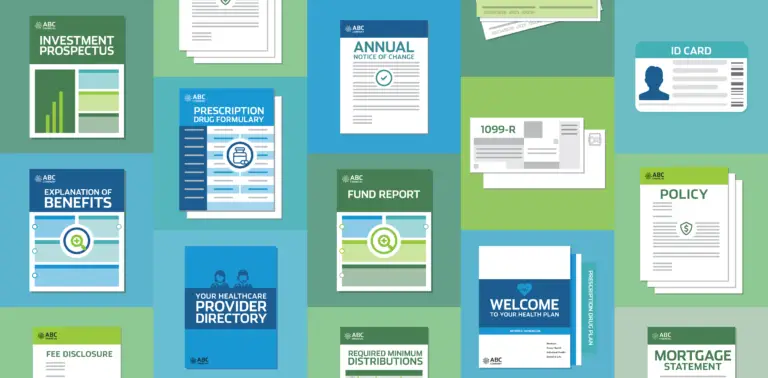
Large health plans routinely manage relationships with a dozen or more vendors across their communication ecosystem—print production, mail fulfillment, email platforms, SMS gateways, digital engagement tools, content management systems, preference centers, and compliance review workflows. Each vendor was selected to solve a specific problem, and most do their individual jobs well.
The cumulative cost of this fragmentation is more complex to see, but substantial. It shows up in the integration work required to maintain data consistency across systems. It shows up in the coordination overhead of managing multiple vendor relationships, contracts, and SLAs. Organizations pay the price in increased compliance risk when they enforce regulatory requirements across distributed production environments. They also pay a strategic tax when lowest-common-denominator integrations constrain member communication capabilities.
Organizations that have consolidated their communication infrastructure report meaningful operational savings—often in the range of 15-20% reduction in total communication spend. But the larger value is strategic: unified platforms enable the integration, velocity, and measurement capabilities that fragmented environments make difficult or impossible. The ROI calculation isn’t just cost reduction; it’s capability acceleration.
Breaking the Plateau
Progress requires addressing root causes rather than intensifying current efforts. The constraint for most organizations isn’t commitment to member experience—it’s the operational architecture underlying that commitment.
That starts with an honest assessment of where integration breaks down—not at the strategy level, where cross-functional alignment is often strong, but at the operational level, where systems and workflows create fragmentation that strategy can’t overcome. The organizations seeing returns on member experience investment have typically addressed infrastructure before intensifying programmatic activity.
It requires building feedback loops that connect communication execution to member outcomes with enough granularity to guide real-time optimization. Annual satisfaction surveys can confirm whether the overall direction is right; they can’t tell you which messages are working and which aren’t.
And it demands a realistic view of vendor ecosystem complexity. Consolidation isn’t always the right answer—sometimes best-of-breed specialization justifies integration overhead. But that calculation should be made deliberately, with full visibility into the true cost of fragmentation, rather than accepted as an inherited condition.
The plans that break through the member experience plateau in 2026 won’t necessarily be the ones that invest the most. They’ll be the ones that invest most effectively—building the operational architecture that allows strategic intent to reach members as coherent, timely, personalized experience rather than well-meaning but disconnected touchpoints.
* * *
O’Neil Digital Solutions works with health plans to close the gap between member experience strategy and operational execution. Our ONEsuite platform provides the integrated infrastructure—unified data, omnichannel orchestration, real-time analytics, and compliance-embedded workflows—that enables communication capability at the speed and scale modern member engagement demands. To discuss how we approach these challenges, visit oneildigitalsolutions.com.
Sources
Deloitte. “2024 Global Health Care Outlook.”
Accenture. “Improving the Healthcare Member Experience Through Digital Transformation.” 2024.
J.D. Power. Healthcare Payer Member Experience Performance Trends, 2020-2024.
Healthcare Financial Management Association. Communication Infrastructure Cost Benchmarking Study.