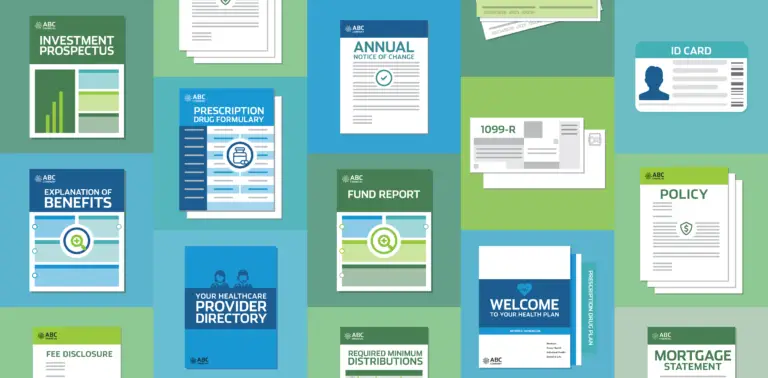

If your organization sends millions of member statements, plan documents, ID cards, or customer communications every year, the USPS is almost certainly offering you money right now — and there’s a good chance no one on your team knows it.
That’s not a knock on anyone. USPS promotions and incentive programs are among the least-understood levers in enterprise communications. They’re announced in postal industry channels most communication leaders never see, they change every year, and nothing about your postage statement tells you what you could have saved. In our experience, many organizations — including large, sophisticated mailers — simply don’t realize these programs exist.
So let’s start at the beginning.
What Are USPS Promotions?
Each year, the USPS publishes a calendar of promotional programs designed to encourage practices it wants to see more of — mail that engages recipients, integrates with digital channels, or supports sustainability goals. Mailers who enroll and meet each program’s requirements earn a postage discount, typically a percentage off qualifying volume during the promotion window.
The catch: these discounts are opt-in. You must register during a defined enrollment period, submit mailpieces for pre-approval, and document compliance. Mail that would have qualified earns nothing if no one enrolled it. That’s the single most important thing to understand about USPS incentives — the value is forfeited by default.
The Programs Worth Knowing
Tactile, Sensory, and Interactive (TSI)
TSI rewards mailpieces with physical characteristics that engage the recipient — textured or specialty paper stocks, interactive folds, sensory elements. This sounds like it requires a redesign; it usually doesn’t. Textured envelope stock can qualify a mail stream with no upfront inventory and minimal upcharge, and some mail already qualifies as-is. Healthcare ID cards, for example, often meet TSI criteria at no added cost.
Sustainability
This promotion rewards environmentally responsible mail practices — recycled content, sustainable production certifications, and related criteria. For organizations with corporate ESG commitments, it effectively pays you for practices you may already be pursuing.
Informed Delivery
Informed Delivery is the USPS service that emails consumers a preview of their incoming mail. The promotion rewards mailers who enhance those previews with interactive digital content — turning a physical mailpiece into a paired digital impression, and earning a discount for it.
The Mail Growth Incentive
Separate from the promotional calendar, the Mail Growth Incentive rewards qualifying growth in mail volume with postage credits applied to your account. Unlike promotions, which discount postage upfront, growth credits must be documented, claimed, and tracked through to receipt — a recovery process that can stretch across many months. It is also, as you’ll see below, where the largest dollars can live.
What Capturing This Actually Looks Like
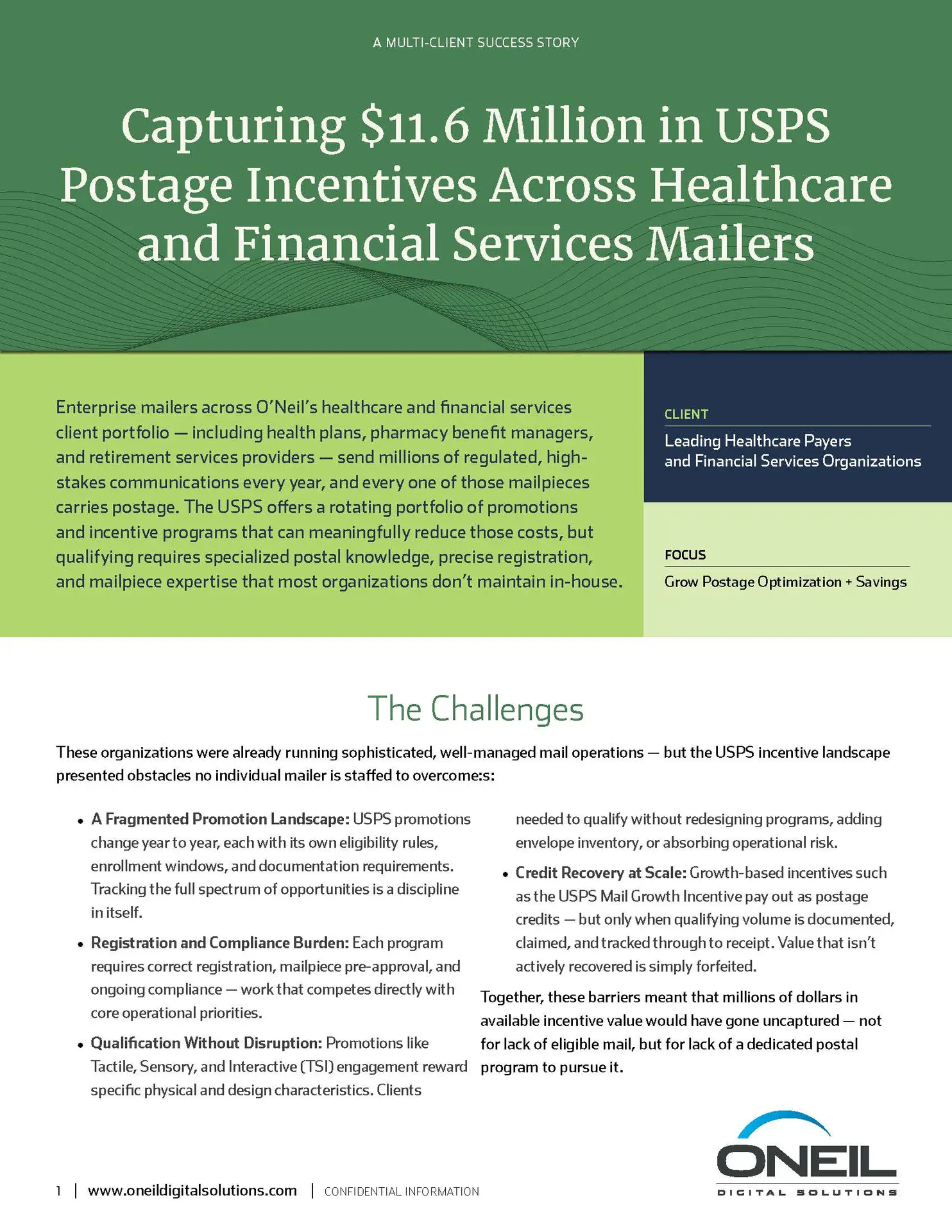
Across the 2025–2026 USPS program cycles, O’Neil’s postage optimization program captured more than $11.6 million in incentive value for clients across healthcare and financial services — health plans, pharmacy benefit managers, and retirement services providers.
That total came from both streams described above: $2.99 million in 2026 promotion incentives — the majority through TSI, with additional value from Sustainability and Informed Delivery — and $8.61 million in Mail Growth Incentive credits recovered across seven client organizations, with individual recoveries ranging from $70K to $2.8M.
Here’s the part that surprises people: none of it required clients to redesign their mail programs, invest in inventory, or change how they operate. The value wasn’t created by changing the mail. It was captured by knowing the programs — which ones were open, which mail streams qualified, how to enroll correctly, and how to follow every credit to confirmed receipt.
Why This Needs to Be Someone’s Job
USPS programs open, close, and change every year. Enrollment windows are narrow. Requirements shift. Credits that aren’t claimed expire quietly. Capturing this value consistently requires a standing postal incentive function — someone tracking every program, mapping it against every mail stream, and managing the full lifecycle from registration to received credit. Very few organizations staff for that internally, and they shouldn’t have to.
That’s the function O’Neil’s postal team — with more than 100 years of combined USPS expertise — performs for its clients as part of a broader postage optimization discipline. The full breakdown of the $11.6 million, program by program, is in our new success story. Read it here — or start with a simpler question: how much incentive value is sitting unclaimed in your own mail streams?