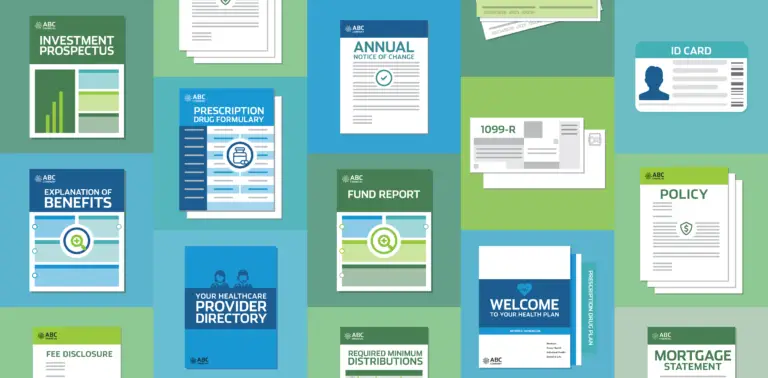

The new-member packet arrives. It is heavy. The plan logo is on the front. There is a benefits summary, an ID card carrier, a welcome letter, a HIPAA notice, and several legally required disclosures that — by design — read like such disclosures. This is the moment member experience in healthcare is either set in motion or quietly forfeited. The member opens it on a kitchen counter, decides which pieces look important, and recycles the rest within a week.
This is treated, across most of the industry, as the onboarding moment. It is not. It is the artifact a plan ships when the actual onboarding moment — the one that decides whether this member will still be a member in three years — has already passed.
The retention curve does not begin when the packet arrives. It begins on the day enrollment is confirmed and is largely set within the first 90 days. Members who form a clear, accurate, and personally relevant understanding of their plan inside that window stay longer, use benefits more appropriately, score the plan higher on CAHPS, and convert into the next plan year with materially less marketing investment. Members who do not are exposed to every churn risk a plan worries about — voluntary disenrollment, network confusion, low utilization of preventive benefits, and the long, quiet drift toward “I never really understood this plan” that surfaces as a switch decision in October.
If you lead member experience or marketing operations at a health plan, the practical question is not whether onboarding matters. It is whether the operating model behind your onboarding can credibly bend the retention curve at all.
The First 90 Days Are Not a Communication Project. They Are a Decision Window.
The most cited reason members switch plans during AEP is some version of “it didn’t fit my needs.” J.D. Power’s 2025 Member Health Plan Study found that members who report low confidence in understanding their benefits are more than twice as likely to consider switching plans within twelve months. Members who report high confidence — most often built in the early months — convert into the next plan year at meaningfully higher rates and recommend the plan at a multiple of the unconfident cohort.
That confidence is built, or not, inside a discrete window. Behavioral research from CMS’s CAHPS national results and consistent findings across regional Blues plans show the same pattern: by day sixty, the member has formed an opinion about how easy this plan is to use, whether the right care is accessible, and whether the plan “knows them.” That opinion is durable. It is also formed on radically thin information — usually two or three communications and one or two service interactions.
The implication is not that plans need to send more communications during onboarding. They need to send the right ones, in the right order, in the channels each member prefers, with content calibrated to the segment that member belongs to. That is an operational problem, not a content problem.
Three Things the Onboarding Window Quietly Decides
Every new-member relationship that erodes within the first year tends to do so for the same three reasons. They are not strategic gaps. They are infrastructure gaps.
Gap 1: Channel preference — set on day one, or assumed forever
Most plans collect a phone number and an email address at enrollment, then default every onboarding communication to print. The member who prefers SMS receives mail. The member who prefers email receives a portal alert and a printed packet that contradict each other on dates. The member who prefers print but actually opens email gets opted into a “go paperless” sequence that moves them out of the channel where they pay attention.
Channel preference inside onboarding is not a settings problem. It is the foundational signal a plan uses to demonstrate that it understands the member it just enrolled. Plans that capture and act on channel preference inside the first two communications quietly stop sending wasted touches; plans that don’t keep paying for envelopes that go straight into recycling.
Gap 2: Plan literacy — sequenced, or fragmented
Health plans are complicated. Onboarding the new member into the plan’s actual mechanics — finding a primary care physician, understanding what is and is not covered, knowing how to handle an out-of-network bill — requires a sequence, not a packet. The packet model attempts to deliver everything at once, on the theory that the member will absorb what they need and ignore the rest.
Members do not absorb at scale. They glance, file, and forget. By the time they actually need to know how to handle a claim adjustment or a prior authorization, the relevant information is in a recycling bin or an unread email two months old. Plans that treat plan literacy as a sixty-to-ninety-day educational sequence — drip, contextual, channel-appropriate — see meaningful lifts in self-service utilization and meaningful drops in avoidable call volume. Plans that ship the packet and hope are not running an onboarding program. They are running a notification.
Gap 3: First-touch problem-solving — generic or contextual
The first time a new member calls the plan or logs into the portal, they have a specific question. They want to find a dentist, confirm a copay, set up a recurring prescription, or understand a bill. The way the plan handles that first interaction is the strongest signal the member receives about the relationship they are entering. A generic call-center handoff or a portal that surfaces the same homepage every other member sees is not first-touch problem-solving. It is first-touch logistics.
Plans that connect onboarding communications to a personalized first portal experience — and to a service interaction primed with onboarding context — convert that first interaction into a retention asset. Plans that do not are training the member to associate the plan with friction at the exact moment they were most willing to associate it with help.
Proof: A regional Medicare Advantage plan
A regional Medicare Advantage plan with roughly 180,000 members had been treating new-member onboarding as a single shipment: one welcome packet, one ID card carrier, one benefits summary, one CMS-required notice. These are the foundation of Medicare Advantage member communications — and, as packaged, they almost never land. The packet was excellent in isolation. It was also the entire program. Member-services call volume spiked at day forty-five through day seventy-five — almost entirely on questions the welcome packet had attempted to answer at day three. Voluntary disenrollment in the second plan year ran above the regional benchmark. The CAHPS “ease of doing business” score had been flat for three years.
Working with O’Neil Digital Solutions, the plan re-architected its onboarding into a four-touch sequence inside ONEsuite: a welcome confirmation in the member’s preferred channel within seventy-two hours of enrollment; a primary-care-physician confirmation and access walk at day ten; a benefits-and-self-service walk at day thirty; a ninety-day check-in that triggered a personalized service outreach if the member had not yet logged in or used a benefit. Channel preference captured at touch one propagated to every subsequent touch. Each communication assembled itself dynamically from a small set of components keyed to plan type, region, language, and segment.
Inside two plan years, voluntary disenrollment in the first-year cohort dropped 3.4 percentage points. CAHPS “ease of doing business” rose six points. Member-services calls in the day forty-five-to-seventy-five window dropped twenty-eight percent — calls the plan never wanted in the first place, since they were a referendum on whether the welcome packet had landed. The packet itself did not change. The architecture around it did.
What an Engineered Onboarding Window Looks Like
The plans that bend the retention curve inside the first ninety days share a small set of operational characteristics. What separates them is member communication strategy built as infrastructure — not intent papered over with a packet. They are not all running the same playbook, but the underlying capabilities converge.
They treat enrollment as the trigger, not the welcome packet. Every onboarding communication is event-driven from the day the member’s record lands in the recordkeeping system. The packet is one component, not the program. Communications fire in a sequence that maps to how new members actually absorb information — not how the plan’s compliance calendar is laid out.
They capture channel preference inside the first two touches and respect it everywhere. The member who tells the plan she wants an email on day three is not receiving printed onboarding mail on day forty. The member who opens SMS but ignores email is migrated to where his attention is, not where the plan’s batch cycle is.
They build content as components, not as templates. A new-member welcome assembles itself from plan-type, region-specific, segment-specific, and language-specific components — the marketing team is not maintaining hundreds of static welcome packets. New plan launches do not require rebuilding from scratch.
They connect onboarding communications to the portal and to member services. The member who opened the day-thirty benefits walk is greeted on the portal with content tied to that walk. The member-services representative answering a day-forty-five call has visibility into which onboarding touches the member has and has not engaged with. The first-touch interaction is contextual — not because the agent guessed, but because the architecture made the context available.
They measure onboarding outcomes against retention, not against open rates. The relevant question is whether the cohort that received the engineered onboarding sequence converts at higher rates into the next plan year, scores higher on CAHPS, uses preventive benefits more appropriately, and generates fewer avoidable service touches. Open rates and click-throughs are leading indicators; retention is the outcome that pays for the program.
The Window Closes Whether You Engineer It or Not
Every member who enrolls is going through an onboarding window within the next 90 days. The question is whether the plan is doing anything purposeful inside it. The plans that are tend to retain those members for years and convert them into advocates. The plans that aren’t — the ones still relying on the packet — are spending their AEP marketing budget every fall reacquiring members they already had.
Onboarding is not the introductory piece of the member journey. It is the piece that decides how long the journey lasts.
* * *
O’Neil Digital Solutions* partners with health plans to engineer member onboarding from a packet into a retention infrastructure. Our ONEsuite platform unifies enrollment data, channel preference, dynamic content composition, and outcome measurement so that the first ninety days become a programmable window — measurable, repeatable, and capable of bending the retention curve. To learn how leading plans are rebuilding the onboarding window, visit oneildigitalsolutions.com*.