
There’s a particular kind of organizational knowledge that only comes with decades of repetition — the kind that doesn’t live in a playbook but in the instincts of a team that has seen every edge case, survived every regulatory shift, and helped clients navigate every seismic change the industry has thrown at them.
For O’Neil Digital Solutions, that knowledge spans more than 50 years. And the clearest way to understand what that means today is to trace not just O’Neil’s journey, but the journey of the communications industry itself — because the two have been inseparable.
Era One: The High-Volume Imperative

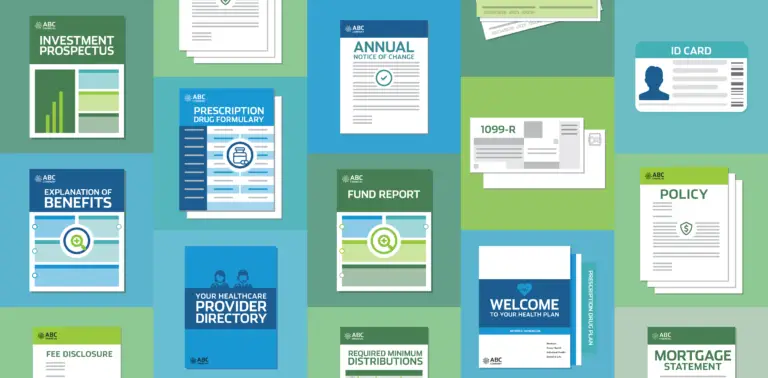
In the early decades of high-volume transactional print, the defining challenge was simple: scale. Healthcare payers and financial institutions were producing enormous quantities of critical documents — Explanation of Benefits statements, member ID cards, enrollment kits, policy disclosures, billing statements — and the operational priority was throughput. Could you print millions of documents accurately, insert them correctly, and get them into the mail on time?
The organizations that answered yes built the foundation of the modern communications industry. They invested in industrial-grade infrastructure, developed deep expertise in document composition, and learned that in regulated industries, a missed print run wasn’t just an operational failure — it was a compliance event with real consequences for real people.
O’Neil was built in that era. The discipline of high-volume, mission-critical production — the absolute intolerance for error, the obsession with SLA performance — is not a feature O’Neil added later. It is the organization’s original operating DNA.
Era Two: Compliance Becomes the Product
As healthcare and financial services regulation matured through the 1990s and 2000s, a second transformation reshaped the industry’s expectations of its communications partners. Print was no longer just a production function — it was a compliance function.
CMS mandated precise formatting, specific language, and non-negotiable delivery windows for documents like Annual Notices of Change and Evidence of Coverage. HIPAA required that member data be handled within increasingly strict security frameworks. FINRA and the SEC imposed parallel controls on financial disclosures. The stakes of getting it wrong escalated dramatically.
This shift separated the commodity print vendors from the strategic partners. Producing a document correctly, on time, within a fully auditable chain of custody, required not just equipment — it required deep regulatory fluency and the systems to enforce compliance at every step of the production process. Organizations that could do this reliably became trusted infrastructure for some of the most sophisticated healthcare plans and financial institutions in the country.
Era Three: Data Intelligence Enters the Picture

The third era arrived when it became clear that the document itself was only part of the story. The data behind the document — who the member was, what their history looked like, what their specific plan terms were, what language they preferred, what channel they were most likely to engage with — was where the real opportunity lived.
Personalization at scale became the defining capability. A health plan managing two million Medicare Advantage members couldn’t send two million versions of the same generic EOB and expect meaningful engagement. The documents that actually moved members to action — that reduced confusion, drove portal adoption, and reinforced trust — were the ones that reflected the individual. And producing them required a fundamentally different approach to document composition: one driven by data logic, not just print templates.
This era also exposed a structural problem that progressive health plans and financial institutions were beginning to feel acutely: vendor fragmentation. Print lived in one place. Digital delivery lived somewhere else. Data management was someone else’s responsibility. A compliance review happened in yet another system. The operational complexity of stitching these together was significant — and the seams showed up as inconsistencies in the member experience.
Era Four: The Omnichannel Present
Today, the most sophisticated organizations in healthcare and financial services have arrived at a foundational insight: the channel is not the strategy. Member preference is the strategy.
Some members want their EOB by mail. Others want it in a secure digital portal the moment it’s generated. Some want a text notification when their ID card ships. Others need documents in accessible formats, as a matter of regulatory obligation and human dignity. The communication infrastructure has to handle all of it seamlessly, from a single source of truth, without creating parallel workflows that multiply cost and risk.

This is the moment the industry has been building toward for five decades. And it’s the moment where the accumulated expertise of an organization like O’Neil — the production discipline of the first era, the compliance rigor of the second, the data intelligence of the third — converges into something genuinely differentiated.
O’Neil’s ONEsuite platform reflects that convergence. It’s not a print management system with digital delivery bolted on, nor a digital platform that outsources print to a third party. It’s an end-to-end CCM and CX infrastructure that manages the full communication lifecycle — from data ingestion and document composition through omnichannel delivery, analytics, and archiving — on a single integrated platform. The result is the kind of operational coherence that eliminates the seams: consistent member experience across every channel, compliance embedded in every workflow, and the analytics to continuously improve both.
The proof is measurable. When a Medicare Advantage plan partnered with O’Neil to drive digital adoption, a 20% increase in member digital opt-ins translated to more than $1 million in monthly postage savings — $12 million annually — without sacrificing the print channel for members who preferred it. When a prominent healthcare company consolidated its fragmented vendor landscape onto ONEsuite, the result was $6 million in savings alongside a unified, enterprise-wide communications strategy built for growth.
What Five Decades Actually Means
It would be easy to characterize O’Neil’s longevity as a legacy credential. It is more accurately understood as a compounding asset. Every regulatory evolution, every technology shift, every client challenge navigated over 50-plus years has deepened the institutional knowledge that informs how O’Neil designs solutions, anticipates risks, and advises clients navigating exactly the complexity they’re facing today.

The communications landscape will keep changing. AI-powered personalization, predictive engagement modeling, and increasingly sophisticated member preferences — each of these represents the next transformation in a progression that shows no signs of slowing. The organizations best positioned to navigate that future aren’t the ones chasing each new capability in isolation. They’re the ones with a partner who has been through the transformations before and knows how to build on what works.
That’s the real story of five decades in mission-critical communications — not the technology that changed, but the commitment to the mission that didn’t.
O’Neil Digital Solutions is a CCM and CX leader serving healthcare and financial services organizations through its ONEsuite platform. With more than 50 years of experience and a track record serving over 125 million members, O’Neil helps clients simplify communication complexity, ensure regulatory compliance, and elevate the member experience. Learn more at oneildigitalsolutions.com.