
How Health Plans Can Turn Member Communication Quality Into Measurable Quality Score Performance
Most conversations about print in healthcare communications begin with a defensive posture — an argument that print hasn’t disappeared, that seniors still prefer it, that digital response rates are lower than marketers admit. Those arguments are true, but they miss the point that matters most to health plan executives right now.
Print is not just a legacy channel worth preserving. For Medicare Advantage plans, it is a direct lever on CAHPS performance — and CAHPS performance is one of the most consequential drivers of CMS Star Ratings, quality bonus payments, and competitive positioning in the MA market. The connection is not theoretical. It runs through a very specific and measurable mechanism: member comprehension.
When members understand their benefits, they use them, and they report better healthcare experiences on the CAHPS survey. Star Ratings improve with Better survey scores. And when Star Ratings improve, plans unlock quality bonus payments, attract higher-value enrollees, and retain members through Annual Enrollment Periods at significantly higher rates.
Print — specifically, personalized, well-designed, strategically timed printed communications — is one of the most underutilized tools health plans have to move that chain. This post makes the case for why.
CAHPS Is the Scorecard. Comprehension Is the Game.
CMS has made member experience the most heavily weighted domain in the Star Ratings program. Since the 2021 Final Rule, CAHPS measures carry a weight of 4 — double that of most clinical measures — making them the single largest determinant of where a plan lands on the five-star scale. The Member Experience and Access to Care domain alone accounts for a majority of a plan’s overall rating.
What CAHPS actually measures is revealing. The survey asks members to assess how well their plan communicates information, how easy it is to get the care they need, how responsive the plan is to their questions, and how clearly they understand their coverage. These are not abstract quality indicators. They are direct reflections of whether a plan’s communications are doing their job — whether members feel informed, supported, and confident in their relationship with the plan.
CAHPS measures carry a weight of 4 in CMS Star Ratings — double the weight of most clinical HEDIS measures — making member experience the most heavily weighted domain in the program.
The plans that score highest on CAHPS are not necessarily the ones with the most digital touchpoints or the highest email open rates. They are the ones whose members — including those in their 70s, 80s, and 90s who have received every plan communication they’ve ever reviewed on paper — actually understand what their plan covers and feel well-served by how the plan communicates with them.
That distinction has meaningful implications for channel strategy. If your highest-volume, most-regulated, most-complex communications are arriving in formats that a substantial portion of your membership finds difficult to access, act on, or retain, you have a comprehension problem that is also a Stars problem.
The Comprehension Gap Is Real — and Measurable
Health plan executives tend to underestimate the significance of the comprehension gap among their membership. Industry research consistently shows that a large proportion of Medicare Advantage members do not fully understand their plan benefits, do not know how to access supplemental benefits they are entitled to, and are confused about cost-sharing obligations until they receive an Explanation of Benefits after a service event.
CMS has acknowledged this challenge explicitly. The original rationale for the now-paused mid-year supplemental benefits notification rule — which required MA plans to send individualized notices to members who had not used supplemental benefits like dental, vision, transportation, and over-the-counter allowances — was precisely that member awareness and utilization of these benefits remained persistently low despite their availability. CMS identified this gap as a direct contributor to weaker member experience scores and poorer health outcomes.
CMS identified low supplemental benefit awareness and utilization as a direct contributor to weaker member experience scores and poorer health outcomes — the original rationale for the mid-year notification rule.
While CMS has proposed removing the mandate, the underlying problem it was designed to solve has not gone away. Members who don’t know they have dental coverage don’t schedule appointments. Members who don’t understand their transportation benefit don’t use it for preventive care visits. Members who are confused about their drug formulary don’t ask the right questions at the pharmacy. Each of these gaps represents a missed opportunity to improve both health outcomes and the CAHPS responses those members will eventually submit.
Print is uniquely positioned to close this gap. A well-designed, personalized benefits summary mailed to a member at key moments in the plan year — at enrollment, at the start of the second half of the year, ahead of AEP — does something that a portal notification or push email cannot reliably accomplish: it exists in the member’s physical environment, can be shared with a spouse or adult child, can be returned to when a benefit is needed, and does not require a login, a remembered password, or a reliable internet connection.
The Member Populations Where Print Does the Most Work
Not all health plan members are equally served by digital communications. Three populations in particular represent both the greatest risk of comprehension and the greatest opportunity for print to drive measurable CAHPS improvement.
High-risk Medicare Advantage members with multiple chronic conditions.
These are the members whose benefit utilization and care management engagement most directly drive Star Ratings performance on HEDIS measures. They are also, statistically, among the oldest members on a plan’s rolls — members for whom printed communications carry the highest trust and comprehension advantage. Personalized care gap letters, medication adherence reminders, and care management outreach that arrives in the mailbox rather than the inbox reach this population with a reliability that digital cannot match.
Dual-eligible members enrolled in D-SNPs and aligned Medicaid programs.
This population carries extraordinary significance for Star Ratings — CMS has noted that non-profit plans, which disproportionately serve dual-eligible and lower-income populations, consistently outperform for-profit plans on Star measures. These members frequently lack reliable broadband access, may have limited smartphone literacy, and depend on physical mail as their primary channel for receiving important communications from government programs and insurance carriers. Digital-first strategies that prioritize digital over print for this population create equity gaps that will appear, with a delay, in CAHPS scores.
New enrollees in the first 90 days of membership.
The onboarding window is when member comprehension is established and when the foundation for long-term engagement — and long-term CAHPS performance — is laid. Research consistently shows that members who clearly understand their benefits from the outset are more likely to utilize preventive services, engage with care management programs, and remain enrolled through subsequent AEPs. A well-executed welcome kit, delivered in print, sets a comprehension baseline that digital onboarding sequences consistently fail to match for most Medicare-eligible new enrollees.
CMS Mandates Print. Plans Should Use It Strategically.
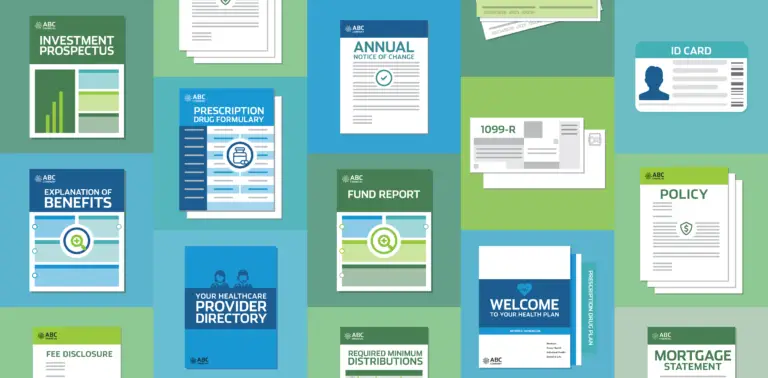
For Medicare Advantage and Part D plans, print is not a discretionary channel. CMS requires that specific communications be delivered in physical form: Annual Notices of Change, Evidence of Coverage documents, Summary of Benefits, formulary updates, ID cards, and certain prior authorization and appeals notifications. These requirements exist because regulators recognize that a meaningful segment of the Medicare population cannot be reliably reached — or reliably protected — through digital channels alone.
Most plans treat these mandated print documents as pure compliance cost. That framing is a strategic mistake. An ANOC that a member reads and understands is not just a regulatory checkbox — it is a direct intervention in that member’s likelihood of making an informed plan selection during AEP, returning for care during the plan year, and reporting a positive experience on their CAHPS survey. The quality of the design, the clarity of the language, the relevance of the personalization, and the timing of the delivery all affect outcomes that ultimately appear in Star Ratings.
The question is not whether to send the ANOC. It is whether the ANOC you’re sending is working — and for which members it isn’t.
Plans that invest in the quality, personalization, and strategic design of their mandated print communications are getting more from every dollar they already spend. Plans that treat those documents as commodity print runs are leaving measurable quality improvement on the table.
The Financial Stakes of Getting This Right
The revenue implications of Star Ratings performance are substantial enough that even incremental CAHPS improvement carries significant financial weight. Medicare Advantage plans achieving four stars or higher receive quality bonus payments — effectively higher capitation rates — that can amount to hundreds of millions of dollars annually for large plans. The difference between a 3.5-star and a 4-star rating is not academic. It determines whether a plan qualifies for those bonuses, and whether it can price its benefits competitively enough to grow enrollment in the next contract year.
CAHPS measures, at their weight of 4, are the single most powerful lever a plan can move to cross the thresholds that separate three-star plans from four-star plans. And the member communication behaviors that drive CAHPS scores — clarity, responsiveness, consistency, comprehension support — are areas where investment in print quality and personalization can produce measurable improvement within a single measurement cycle.
Medicare Advantage plans achieving 4+ stars receive quality bonus payments that can represent hundreds of millions of dollars annually for large plans, with CAHPS measures, weighted at 4x, serving as the primary rating driver.
For plan executives evaluating communication investments, the return calculation should not be limited to cost-per-piece or postage optimization. It should include the quality bonus revenue at stake for every tenth-of-a-star improvement in CAHPS performance — and the member retention value of the members who stay enrolled because they felt well-informed and well-served by their plan’s communications throughout the year.
What a Print-as-Strategy Framework Looks Like
Health plans that treat print as a Star Ratings asset rather than a compliance cost organize their approach around three principles.
Personalization at the member level, not the segment level.
The most impactful print communications are those that reflect what a specific member has and has not done — benefits they haven’t used, care gaps they haven’t closed, changes to their plan that affect them specifically. This requires data integration between the communication platform and the plan’s enrollment, claims, and utilization systems. Plans with mature CCM infrastructure can produce printed documents that feel as individually tailored as any digital experience — and that reach members who digital channels cannot.
Strategic timing aligned to the member journey.
Print is most powerful when it arrives at moments of decision and transition: the onboarding window, the mid-year benefits utilization check-in, the pre-AEP retention sequence, and the post-disenrollment period when re-engagement is possible. These are the moments when comprehension gaps are most costly and when a well-timed physical communication can directly influence behavior that will eventually appear in a CAHPS response.
Integration with digital follow-through.
Print is most effective not as a standalone channel but as the anchor of an orchestrated communication sequence. A personalized benefits summary delivered in print, with a QR code linking to the member’s portal benefits summary, followed by a targeted email reinforcing the key action — this architecture consistently outperforms either channel alone. The print piece establishes context and trust. The digital elements provide the pathway to action. Together, they drive the engagement behaviors that improve both health outcomes and CAHPS scores.
The Strategic Conclusion
The conversation about print in healthcare member communications has been too often framed as a rearguard action — a defense of a channel under pressure from digital transformation. For Medicare Advantage plans, that framing is not just wrong. It is strategically counterproductive.
Print, when thoughtfully invested in and managed with the same data discipline and personalization capabilities that plans bring to their digital channels, is one of the most direct paths to CAHPS improvement. And CAHPS improvement — given its weight in the Star Ratings program and the financial consequences that follow from it — is one of the most valuable investments a plan can make.
The plans that will lead on Star Ratings in the years ahead will not be defined by how aggressively they went digital. They will be defined by how intelligently they orchestrated every channel available to them — including the one that reaches the members who matter most, at the moments that matter most, in the format they trust most.
The question is not whether print belongs in your member communication strategy. It is whether you are using it with the intention and intelligence it deserves.
About O’Neil Digital Solutions
O’Neil Digital Solutions is a leader in Customer Communications Management (CCM) and Customer Experience (CX) solutions for healthcare payers. Our ONEsuite® platform unifies print and digital communications on a single, AI-powered infrastructure — enabling Medicare Advantage, Medicaid, and commercial health plans to deliver personalized, compliant, omnichannel member communications that improve engagement, support CAHPS performance, and drive measurable outcomes. With over 50 years of industry experience and a track record serving more than 125 million members, O’Neil helps organizations reduce operational complexity while elevating the member experience.
Explore how O’Neil can strengthen your member communications strategy at www.oneildigitalsolutions.com